
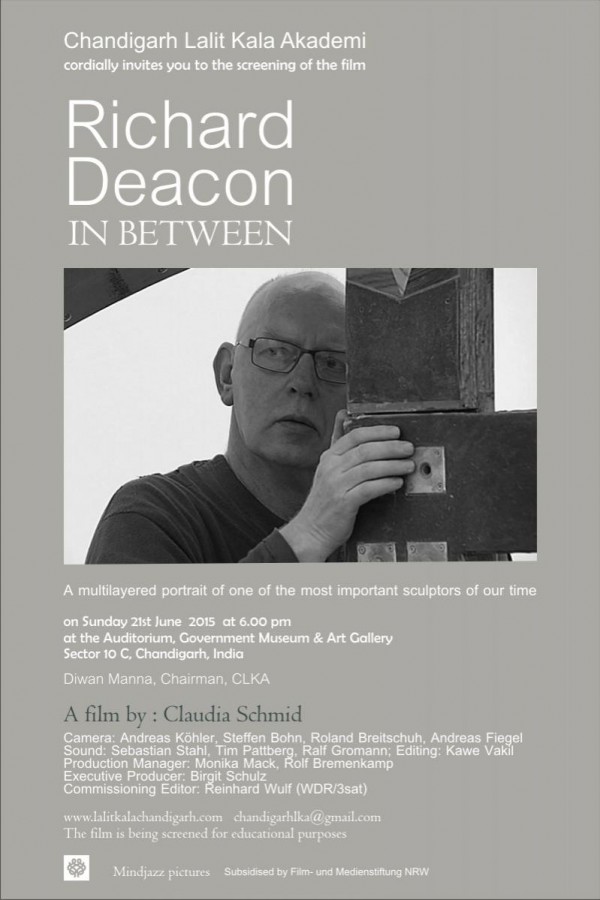
British-born artist Richard Deacon ranks as one of the most important sculptors in contemporary art. His profound interest in the nature of materials and the ways in which they can be manipulated, as well as his innovative approach to form, make him one of the most inventive artists working today. With his existential contemplation of space and form, Deacon has paved the way for a whole new perspective. More than virtually any other sculptor, he draws out all possibilities of expression, creating a complex spatial dynamic from an organic and industrial language of form. The physical approach taken with the different materials is a key element in this regard. His sweeping, wave-like sculptures, with their rhythmic interweaving and biomorphic-looking structures are among the most complex works in modern sculpture. The multi-layered nature of the works reflects the innate complexity of life and stir the beholder to intensive reflection. Film-maker Claudia Schmid has been observing Richard Deacon’s work for two years. Mutual understanding and trust between the two individuals grew during this intense time, making it possible to portray this shy artist, even in quiet moments away from the public eye. All of which results in a unique insight into the personality of the artist and his work.
Richard Deacon was born 15 August 1949, Bangor, Wales, and studied at Somerset College of Art, Taunton, from 1968-69, St Martins School of Art, London, from 1969-72 and the Royal College of Art, London, from 1974-77. He received international acclaim during the early 1980s with his inclusion in important group exhibitions at the Tate, ICA, Hayward and Serpentine Galleries in London; the Central and South American tour of Transformations: New British Sculpture, (1983); and the Museum of Modern Art, New York (1984). Deacon was a Visiting Lecturer and Visiting Professor at various art schools and art institutions since 1977. He was Advisor to Rijksakademie van Beelden Kunsten, Amsterdam, since 1996 and Professor at Ecole Nationale Superieure des Beaux Arts, Paris since 1999. Since 2009 he has been Professor at the Dusseldorf Kunstakademie. Deacon’s work was brought to the US public attention through the landmark exhibition, A Quiet Revolution: British Sculpture Since 1965, that toured from Chicago’s Museum of Contemporary Art to the San Francisco Museum of Modern Art and Newport Harbor Art Museum in California, as well as the Hirshhorn Museum, Washington, D.C., and the Albright-Knox Gallery, Buffalo, NY (1987). A major exhibition of his works toured South American Museums in 1995/96, followed by exhibitions in museums and major public institutions in Britain, the United States, Spain, Germany, France, Finland and Switzerland. Richard Deacon won the Turner Prize in 1987 and the Robert Jakobsen Prize, Museum Würth, Künzelsau, Germany, in 1995. In 1997 he was awarded Chevalier des Arts et des Lettres, France, elected a Royal Academician in 1998 and made CBE in 1999. In 2005 the University of Leicester awarded him an honorary doctorate. He was elected a member of the Akademie der Kunst in Berlin in 2010. Tate Britain mounted a major retrospective of his work in 2014. There have been recent solo museum exhibitions in Germany, France and Spain and solo exhibitions in New York, Copenhagen, and Singapore, among others. He lives and works in London.
